
As a few might have noticed, I have started drawing some cartoon frames. Here's an explanation and a presentation of the concept it has developed into:
note: this post needs a thorough work-over: as is now sections have been added as the ideas developed, so on top below the latest added section with a sketched up plot idea. Then a presentation of some possible characters and some of my work experiments with animation. Further down it's more like a brainstorm with things appearing somewhat fragmented and disordered.
Also; the format of the text seems to change in some sections. I haven't, yet, been able to identify the cause, but I hope you'll be able to ignore it.
Plot sketch for longer dramatic story:
(note: I'm now using AI to research to what degree an idea like that of the below sketched up network can fit into the real World history. So far I think it's progressing in a promissing way. The description in the plot sketch hasn't been adjusted accordingly yet. So far, however most of the idea appears to be possible to get to fit, but it looks like the establishing of the network and how and why it reached its described present day shape needs a stepwise explanation. . You can acces the stored sessions as PDFs via this link
Research material: historical context and methods psychological violence/warfare )
While I'm continuing work on small animated fragments offering glimpses into the Agent First Network environment, I’ve started developing this plot which I think could work as a full length animated movie, a novel – perhaps graphic – a “traditional” movie or as a tv-series.
Environment:
An Intelligence informant-agent network (in the following: the Agent First Network or just the Network) in which the agents form couples and recruit their own children.
The recruiting is done in a process starting soon after the children are born. To begin with they are used as props by their parents when they take part in training operations (the training operations often are believed by the agents to target sexual predators, and the children are in such operations used to signal the “knowledge” to the target of him/her being a paedophile).
Gradually the children will become more active, and they’ll be channelled into friendships with other Network children. This will become the base of their teenage lives, and from there they’ll enter educations and professions of all kinds.
But, whatever they choose; for the main part of them the identity as being an agent comes first (meaning: if they become lawyers they’ll inform on their clients if they see a reason to or if asked to do so by their handlers. If they become journalists they will reveal sources and they’ll infiltrate groups of other journalists to get to their sources if asked to. And it’ll be their primary ambition – from back in those teenage days – to excel as agents by being able to deliver that information. And that is one of the great advantages of operating the Network in this way: all the agents (or close to) are in their understanding of themselves agents first, and whatever profession they have been educated to work in therefore comes second which reduces issues with conflicts of conscience. In effect these individuals exists in the World in a different way than others – they’re viewing the World as a scene to be explored for oppertunities to perform as an agent
The relative ease of maintaining the Network with new recruits, and the reduced issues concerning lonliness by securing of a safe space for the agents with each other in the families are other advantages. And by letting agent families have friendships with other agent families quite large safe spaces can be established so that conditions to develop socially are improved.
Historical frame:
The story takes place in the present time and is sought to be wowen into the real history of the World.
The place is a smaller western style democracy country (like Denmark) that is part of a larger alliance (like NATO). And in this country – as in the rest of the alliance – the Agent First Network was established just after WW2, and was shaped to prevent regimes similar to the German Nazi-regime from developing again, and also to pay attention to communist and left wing movements.
The decision to create agent families had to some extend been inspired by the results with regards to loyalty and dedication seen produced by the nazi regime’s Hitler Jugend. Hitler Jugend only existed for about a decade, but one of the aims with the organisation had been to instil an absolute loyalty in the members for that loyalty to be central in new families started by Hitler Jugend members to start families so that the parents wouldn’t consider anything other than to bring their children into the organisation too. Hitler Jugend didn’t develope that far, but fanatical loyalty produced in young soldiers had made an impression.
Along with that the Soviet Octobrist-Pioneer-Komsomol youth structure worked to create the argument that – in order to counter the threats to the security of the members of the alliance – building an organisation that engaged its members from childhood was necessary.
Therefore, at present, the Agent First Network has an about 80 years long history with its 5. generation being born these years. It looks like this:
Generation I: adults, mainly younger, during 1940 - 1945
Generation II: the children of 1. generation, born ca 1935 - 1955
Generation III: born 1960 - 1980 (narrowing it down, some).
Generation IV: born 1990 - 2010
Generation V: born 2020 -
This means that about half generation II and and all those born later have all been agents all of their lives, which in some sense means that is all they know.
That’s an important thing to try to make understandable – how deeply they’re involved, and the importance being an agent has for them. What it gives them and what looms in their subconscience of knowledge of severe punishments to keep them from developing critical thoughts concerning what they are part of.
These are important and serious aspects and I will work to explore and to unfold these during the drama, but most relevant to the structure of the plot is that over the history of the Network there has been a development in the policy regarding the recruiting of the children.
At the present the Network therefore has an almost 80 years long history, and – most relevant to this plot – there has been a development with regards to how firm the policy about recruiting one's own children has been/is. At present the policy is that all children of agent couples have to become integrated in the Network, but at the start the policy was less firm. This has to do with a gradually increased understanding in the Network of the difficulties such un-recruited children create in otherwise fully recruited families – how they disturb the safe relaxed space that the family would otherwise have, when alone, to be honest and to discuss/talk about/share their agent work experiences. How they might be possible to exploit by hostile intelligence organisations to get information about the surrounding agent family. How they’d keep being a disturbance the rest of their lives. How they might get to hear secrets from small children in the family (like from children of siblings or cousins). And how their children would continue the disturbance as grandchildren/nephews/nieces/cousins.
At present all children of agent couples are – without exceptions – to be brought into the Network, but to begin with things were different. When the Network was started, those who built and directed it had not themselves been raised inside the Network, of course, instead those who formed the structure, then, was to a large extend people who had taken part in resistance against the occupation of their countries by the nazi regime which meant that they had experienced the psycological demands of secret activities under threats to their lives and the lives of their fellow resistance fighters. So when they built they built from those experiences, and one of the things those experiences told them was that being a secret informant agent couldn’t be for everyone which meant that, back then, in some of the families one or more children were assessed to not be suited as agents and were therefore not brought into the Network.
Another thing was that the closeness of having experienced their countries being occupied was a strong motivation to participate in safeguarding the reestablished democracies which was part of why the thought of not making recruitment of the members children optional was alien. But in general at that time the network was pioneering which meant that a lot of experiences had yet to be had.
So the policy of being selective was in place when generation I chose who to recruit among their own children and I think I’ll say that it remained in place some time into the early 1970s* .
During this time, though. it had become more and more clear that having an unrecruited child in an otherwise fully recruited family caused difficulties.
One being that the rest of the family had to keep their agent lives secret from the unrecruited son/daughter/brother/sister which meant that instead of relaxing and sharing their experiences when together at home; in families with an unrecruited child the members would still be under stress to be careful about what they said.
And not only would there be the personal danger of being revealed as an agent for individual family members, or for the family as a whole, but the existence of an intelligence network involving children – if revealed – would be a scandal of unimaginable dimensions, so the secrecy could not be taken lightly.
The unrecruited might also be possible to exploit by hostile intelligence organisations to get information about the surrounding agent family.
And an unrecruited child will keep being a disturbance and a risk to the Network for the rest of their lives. And if they have children, the disturbance will go on with the risk being those children hearing secrets from cousins, for instance.
So, over time – as the understanding of the difficulties caused by the unrecruited inside agent families grew – the policy was changed into one where all children had to be integrated, and where rolls then had to be created for those who had one or another kind of weakness (so that being an agent could now be for all).
Another thing, which has played a role in the policy change, is that to begin with the Network was organised and operated by personnel that had not been brought up inside the Network, but over time increasingly, the Network has been operated by persons shaped by being agents from before they could remember. This bias has been an important factor in deciding that all children of agent couples without exceptions have to be integrated in the Network **.
At the point where there were no longer any exceptions to children of agent couples being integrated, quite a number of individuals were already un-knowingly living as un-recruited inside Network families, and the earlier mentioned bias again played a role in deciding that a firm policy going forward wasn’t enough, given how long it takes before such an unrecruited child is no longer in the Network family structure, (which, as mentioned above, in some cases might be impossible to determine, since they might have children themselves).
So, what at some point was decided was/is to also work actively to purify the Network.
The cleansing measures employed that I've thought of so far:
By preventing those not recruited as children from getting children themselves by disrupting relationships (could be by derailing the targets themselves by seducing them into having affairs or by working on their partner romantically or by influencing their opinion of the target).
By destroying their physical or mental health (which would work towards them not getting children, but also in some cases towards an earlier death, either from illness, substance abuse or by suicide).
By killing them "directly" in apparent accidents, suicides, crimes, etc. etc. (this will primarily be done if it has to happen fast – could be because of an acute danger to the secrecy of the Network).
By framing them as creeps to be used as targets in the live target training operations mentioned earlier.
Most of these measures are long processes that require a lot of manpower and planning, but – as described elsewhere in this post – the Network is vastly oversized with regards to actual security tasks, it therefore craves tasks for the members to experience being needed as agents. It also craves targets for the live target training operations which are central in team building and intra Network socialising.
(for these live target operations big concentrations of agents are created in the relevant area both by rotating in agents from the rest of the country, and also, as tourists, agents from the other countries in the alliance – they hang out with each other during the day, ready to get into action if the target’s movements requires them to. At night they party and share their experiences and meet also-in-the-Network partners)
So the purification actually is a big win for the Network.
However those loosely described large concentration training operations comes only after a very long period of observation, planning and preparation: the Network has first tasked Network members with crowding and befriending those not recruited as children, to keep a constant track on them, and to pick up on any signs of weaknesses that might be exploited or/and expanded. in other words, the surveillance will tell the Network operators in what way the polluting elements can be destroyed – can they be made ill phsycally or mentally? can they be brought into situations where lethal accidents are easy to get to happen? Are they creeps? or can they be framed as one?
As things progress the close guarding will also enable the Network to work on how to torpedo romantic relationships very early, and will constantly supply information on how things are progressing in the different processes started to drive them towards being stressed, mentally ill, start substance abuse or getting corrupted.
That these actions by the Network members are part of a purification agenda is not shared below a certain level in the organisation, instead the members are given other explanations (if any) for the orders they receive with regards to those not recruited as children.
Plot aim and skeleton: After bringing the audience into the environment of the Network, the story should reveal the huge ongoing "purification" operation to the viewer/reader and let her/him follow a fight to bring it to an end / have it stopped / get some(one) to stop it.
Much like in the small animated fragment that I’m working on to test ideas for animation ( can be seen as Fragment-001 in my “Agent First, sketches” playlist on YouTube), I'm considering to start with bringing the viewer into the Network environment by following a network member. It might be the girl in that same fragment, but at a time when she’s older; 16-25 perhaps. Curiosity and/or suspicions brings her in contact with knowledge about what it is that she has been “mentally programmed” to take part in.

As touched on before in the description of the historical frame, as part of this project I have developed ideas about how the training and loyalty-building is structured. Those methods should be part of the story too, to get the audience to understand the extent of manipulation, control and direction employed inside and through the Network, and also to make it understandable how dangerous it will be to be in discord with the Network and how difficult it will be to be so undetected.
I’m thinking that the girl could get to know that the live target of one such training operations happens to be the only un-recruited member of a family in which all the other members are Network members. The convenience of that particular individual turning out to be a “huntable” creep sparks the first – or confirms already existing – sceptical thoughts about what is actually going on.
A group forms around her (or she connects to an existing group, or she’s already in a group that she influences), they expand their knowledge, they try to figure out and to agree on what they think of the things they find, what to do about it, and how, while having to avoid suspicion from other Network members. They form a plan, and they execute.
*: I haven’t developed the explanation for specifying when the policy was ended, so this might change a little, but not in a way that’ll have any significant effect on the plot.
**: Perhaps a scenario can be thought up that can handle very rare cases where all attempts to persuade a couple, that is reluctant to integrate their child, fails. Perhaps the couple would be given the choice togethechildr with their to emigrate and to sever all ties to their families. Perhaps, but this plays only an insignificant role in the general picture, and I don’t think it’ll have to be brought up and specified to make this story work.
That's how far I've come (only) with a traditional drama story to take place in the Agent First environment. Right below you'll find a presentation of some maybe characters.
Characters (so far):
- The Young Girl: the possible main character mentioned above in the plot description.
- The Father (of The Young Girl):
The drawing below is made for the earlier mentioned fragment_001 which takes place as the girl is just beginning to be trained by her parents so he'll be at least 10-15 years older at the time when his daughter starts to realise what it is she's been made part of.

This character might not appear in the longer drama, but is developed for the test/pilot, fragment_001. This isn't a person we get to know anything about except that he's being subjected to the Networks attempt to destroy his mental health through ultra frequent provocations resulting in adreanaline (stress hormone) release.

- The Mother (of The Young Girl):
The Mother isn't present in fragment_001, but will be part of the longer drama, and will be important in portraying what surrounds The Young Girl, and what she'll have to confront in her rebellion. I'm still working on developing her, but – as with The Father – in the drawing below she's somewhat younger than what I plan for her to be at the time of the drama.

Getting derailed.
If it develops into a network dominated by a power-elite and with nepotistic tendencies? perhaps under the pretext that it's too work demanding monitoring the mindsets of such a large network (something to work with here)
It must be assumed that such a development would be destructive professionalism and thus to security and should be avoided/reversed.
- could be one issue
Another could be what happens if the idea develops inside the network that it's necessary to establish some kind of control of the political level in order to prevent undesirable/undemocratic forces from taking advantage of democracy to bring the country in a direction that would be perceived as undemocratic/dangerous.
If you should find yourself in a situation where you have to deal with such a problem/danger which probably can't be dismissed as not real, then ... what? Do you trust democracy? Do you decide that the constitutional system will have to stand the test even if you are unsure whether or not it'll fail? or do you choose to work toward establishing some sort of control?
Difficult decision, I think, ... because to some extent it will probably be an evasion of responsibility "just" to adhere to the rules / legislation, without having come to the conclusion that it musdt be believed to be the most sustainable way.
.... but but but if one imagines a development into something that includes establishing control within the political / democratic sphere and then mix it with corrupt tendencies, then it'll probably be difficult to limit it to what is (believed to be) necessary.
And where and how would such a network ensure an anchoring of the extremely important awareness of challenges to remaining impartial if – out of distrust – it decided to keep the political power in the dark?
Habitual thinking and/or erosion of awareness should be expected to arise here ao that no sustained efforts are made to challenge the distrust and to maintain an aim for something more ideal for a democracy.
Something like this seems like an obvious theoretical danger, and if one also imagines a two-legged structure, where one leg – the political – is responsible for allocating funds to the other – the security area – and this primarily on the basis of what the service itself claims as the threat level and what it will require in terms of manpower and equipment (= funds), and that while politicians are competing to provide security to the population and therefore are afraid of being confronted with consequences of a reluctant policy with regards to funding security services.
In addition to the obvious unhealthiness of such a structure one might also develop some scenarios where a ... hmmm. problematic shared interest in – as some kind of kickback, perhaps – in abusing security resources to suppress cases/issues/persoins that could be perceived as threat to personal interests.
If the body supposed to detect and intervene in such cases of abuse is weak, and moreover, if it to a large extend is occupied with stakeholdes in possible cases, things could probably end up getting quite fare out.
Numbers:
With regards to the numbers, then an earlier 4 - 5% suggestion was kind of a minimalist guess at what might be needed for a reasonable coverage – with something like a 1 in 20 - 25 representation I loosely speculated it would be possible to be close enough to any one person who might appear to need to be gauged further for persuasion and tendencies – and if spread evenly, perhaps it might, however; it has since occurred to me that there is a maximalist way of approaching the issue as well. Here the questions to ask – I think – would be: what is the highest number of informant agents that can be handled/organised, and at what point will the percentage be so, that there’ll be an uacceptabelly high risk of threatening cells forming inside the Network. There might also be a need for the agents to perceive themselves as something special, which would require them to be a clear minority.
Having thought about this for a while, it has become quite clear to me that the maximalist approach (or something resembling that) has some obvious advantages in the set-up I’m working with: the coverage would be much improved and such an abundance of agents would change the work of figuring out where to infiltrate to be, instead, one only of monitoring that everything was.
With very high numbers, like maybe nearing 1 in 5 of the population recruited/organised, the demand for commitment level could differ a lot between different types of agents. I’m thinking of a layered structure with a full time professional and officially employed core with (close to) full knowledge.
The unpaid unofficial Network members might handle or be part of:
Task forces working on specific operations.
Handlers and/or instructors of other agent with less experience.
Informant agents taking part in operations.
Informant agents surveying/monitoring general activity around them in the workplace and social circles.
Supporters/hinterland for informant agents doing infiltration (often parents).
Suppliers/logistics organisers (platforms, accommodations, safe spaces for meeting, paying jobs, partners and whatever might be needed for things to run as smoothly as possible).
Reserves loosely attached, but possible to mobilise (like when needed to flood a scene for instance).
(...just what came to mind, but the image of something that involves a lot more than just the observing informant agents starts to seem like something I’ll inevitably have to look at for the Network environment)
Those forming the support structure will also, of course, have their eyes an ears open, but they'll not be working on getting into positions or relations of particular interest to the Network.
Training operations (often live target / minimal risk operations) keeps the structure fit and the members busy (=occupied) and committed.
Parallel society: the narrative moves towards something that has developed into a parallel society. A model to describe this? maybe: I. motivation?) II. benefits? III. "side effects"? IV. the choices that lead to this?
(But) the overall picture, at the time of beginning of this story about the network:
Corrupt and beyond democratic control. I. "undeclared" members of the network who are politicians participate in allocating funds to themselves (to the network, that is); II. "undeclared" network members in politics participate in approving initiatives of the network. III. the initiatives the network is set to carry out will often be based on an absolute trust from the broad field of politicians in the information they receive from the network. (this means there'll be a lot of leeway for something autonomous if/when the network decides that it is necessary/preferable). IV. the network's resources could be used to make its members in politics significantly stronger than their competitors (gather non-public information, leak dirt on competitors etc.).
V. also – since the Network is international – democratic restrictions (examples could be demands for warrants for phonetaps or secret ransacking) can be bypassed by having a friendly foreign secret security service performing those tasks.
VI: using "training" as a cover or using low risk operations for training (/teambuilding/commitment maintenance) will hide activities in the accounting.
Abuses its power and gets abused. I. the network sometimes chooses to misinform and manipulate politicians into approving initiatives which are actually extrajudicial use of powers/coercion/punishment.
II. and through this, with the extrajudicial abuses, a practice has been established that can also be exploited by politicians who are willing to overstep their authority and abuse their power to order problematic people taken down.. III. these extrajudicial operations are used to train the network and keep the members committed (see "IV"), which has generated a dependency on being able to continually find a sufficient number of problematic people to satisfy the need for training. IV. This need is increased by the network being greatly oversized compared to the amount of actual work. This again has to do with the recruitment method. This also has caused the network to contain a large number of unsuited members who aren't given assignments.
Therefore at the present the training through executing extrajudicial abuses has become pivotal in maintain loyalty and satisfaction in the network, where they give less suited members a sense of being active agents and sense of worth. Besides this the operations function as a kind of social gathering, where the members - in addition to the excitement - experience a feeling of community around their secret lives, which is otherwise – by definition – impossible.
And since the importance and purpose of these training operations executing extrajudicial abuses of problematic persons have moved to work to satisfy emotional needs in the network they have become a drug.
(internally, the talk will not be of a slide in ethics, but about having the courage and willingness to do what's necessary. This evolved consensus of what is necessary and the conditions for questioning this should contain plenty of materiaI. but at the point of this narrative the relevant question will probably be whether it's necessary to continue or if – on the contrary – it's necessary to change course)
The vulnerability and addiction to the abuses can be made visible by considerations of what it might lead to if such a large number of people (as the entire network) doesn't get their drug, for example:
Will there be potential serious dangers to the network if widespread dissatisfaction arises? Will loyalty and readiness to obey orders be reduced? Will secrets start leaking?
Favoritism: One could work with the idea that the network, through its secrecy, may have built up concentrated representations among employees in companies and institutions that are considered critical. It would affect the output, which might mean that it would be keept at a low level in industry / production / technology, but within culture and media institutions it might have escalated. (a driving force in this escalating far beyond security needs could be the wish among network members to be able to share their secret lives with coworkers. In other word: a result of loneliness) It is possible as well to imagine favoritism among network members in business - when deciding where to place orders in even fields, e.g. cleaning, it wold seem like an option to direct those to businesses owned/run by network members. And, as within politics, one could possibly take it a step further and develope ideas about how the resources of the network would make it possible to provide informational benefits to its members that could ensure advantages in competitive bids, where they aren't favored by the costumer.
Security Service Home Guard: what if one imagines it as a kind of security service home guard? Perhaps intertwined with the military Home Guard? So, maybe a basis in the military / Home Guard and / or with the ability to mobilize from these networks - maybe even with potential families ... but of course not limited to this; people will be recruited, from/in environments that lack representation and/or people who are particularly interesting in connection to specific operations. Sometimes network members can act as bridgeheads if very close coverage is to be established – could be at a workplace. If in general no salary is given? - perks - exciting tasks - ....even assignments abroad (= action holiday-like travel) - excitement, party, community, flirt, sex, relationship-partners. - a shared focus to be enjoyed in participating families. Eg parents with children old enough to understand that they are doing something special together, and, in some cases, parents who get to support - and be proud of - adult children acting in, seemingly, shabby agent roles "on their own".
Fanaticism / sect tendencies: What will the effect be to an individuals' ability to be critical if they have been born and raised as informant-agents? If performing as an agent has been an essential part of gaining recognition all through childhood? (this again puts emphasis on the importance of the training tasks. Here as a tool to ensure that these very strong factors in personality formation can be arranged to work in favour of the network)
Also some ideas about the network organisation cultivating a particular self-perception among its members from childhood and up. First, perhaps, through very small family-vacation-like gatherings with just one or two other children where the common understanding of their status and importance can be conveyed (and community of the belief thereof enjoyed). Later I imagine camps/courses for a bit larger groups of teenagers (will require them to be considered to be able to keep the activities secret).
The readiness to perform tasks without being critical will be significantly increased when the performance has been linked to experiencing pleasure/desire, which I imagine will be the result of such a from-child-training-environment.
A kind of robotization, one might call it. Critical thinking will also be hampered, subconsciously, if it threatens to open up to questions/perceptions that will lead to exclusion from the environment one has identified with and committed oneself to throughout one's entire upbringing. An exclusion will be exacerbated by the fact that one outside the network environment will be isolated with knowledge that one will not dare to share with anyone (e.g. because you know that it will be punished) – a stark contrast to within the network, where that is what you have in common. So in a sense, the psychological forces at play – I imagine – will be reminiscent of how it might look in sects/narrow denominations.
Alternative options
(for taking care of security): Something that can be an answer to the concern about what might happen if the course is altered, and which can also funktion as an expression of ethical considerations in the present. Density and systematics and the need for manpower? are everyone being checked? systematically? are everyone categorised? in groups with different degrees of need for attention? some assessed as not having the potential to develop into a hazard and therefore not to require further checks. Some as with varying degrees of uncertainty and which therefore need to be checked up again with varying frequency, and then – of course – those who are assessed to require more permanent supervision?
(to get an idea of the consequences of a changed work pattern) If that's the picture, then how many can a person categorise in a year? or how much work is there – on average – in categorising one person? With an early and deeply embedded informant network, that people are generally unaware of, it would be quite easy to test different a person against different topics and compile the information.
if the informant network doesn't include children/young teenagers?
It should still be possible to gather the necessary information – I think – even if it would have to be in a somewhat more indirect way. But basically – I think – the main challenge would be to develop new methodologies.
So; it should be possible to picture a scenario with an practice that have an alternative.
And therefore: no ethical dilemma. Only a practical and – possibly – economic task, which should dictate an end to existing recruiting practices and a restructuring. Such a restructuring would probably go towards an increased professionalism and a – presumably – quite substantial down seizing of the informant network (which must be crammed with what can probably be called dead weight). This should also mean the perverted real-life training ops. will become redundant (and therefore can be abandoned), since the camp-party-herd mentallity-culture in which they are central would be dismantled or transformed into a culture where there isn't internal prestige in outrageousness, and where – I think – the organisation would work with a structure of more separate cells.
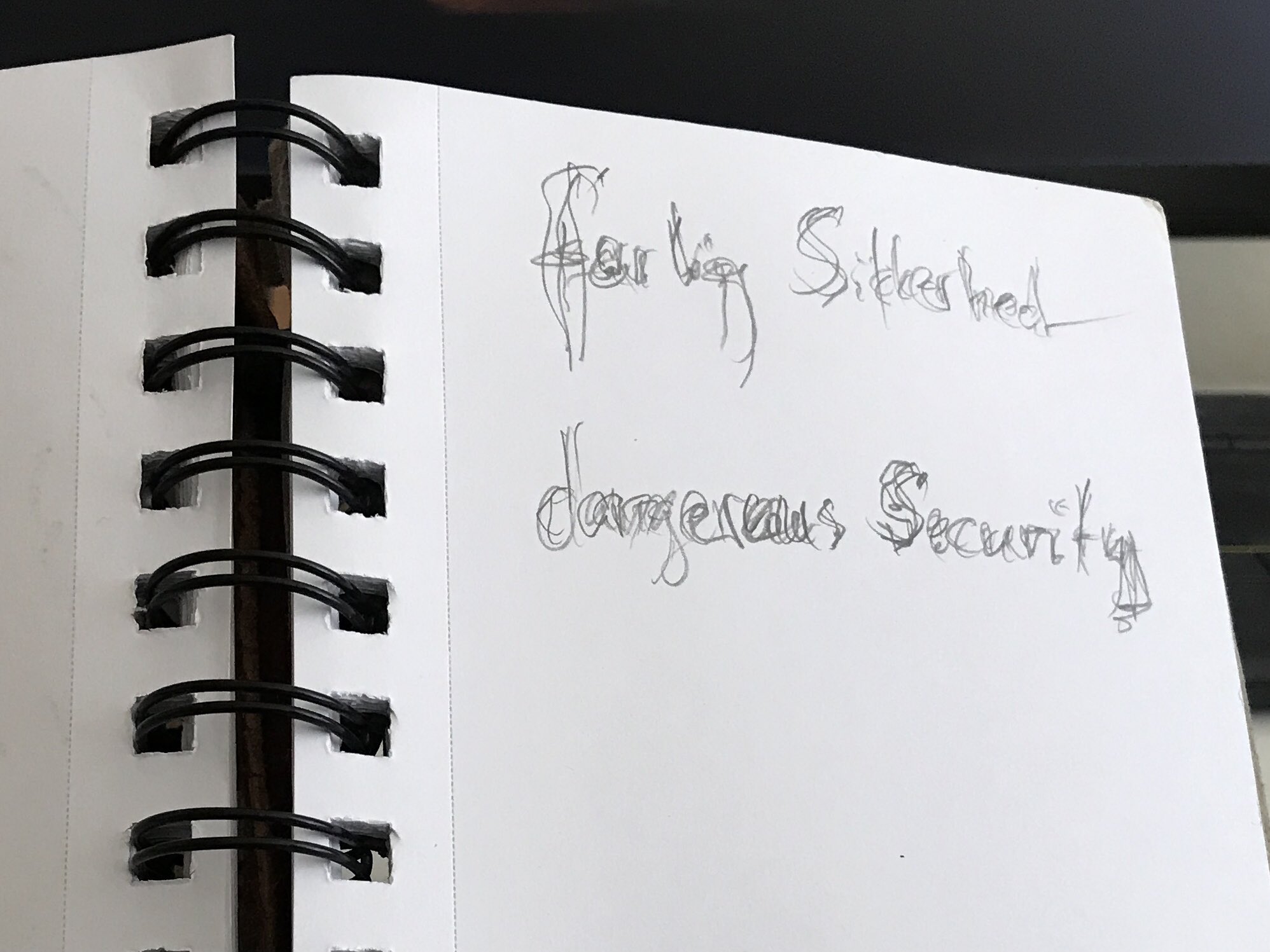
Inspirations/things that might fit in:
I've come across a few mentionings of phenomenons, that might be interesting to use to develope this project.
 |
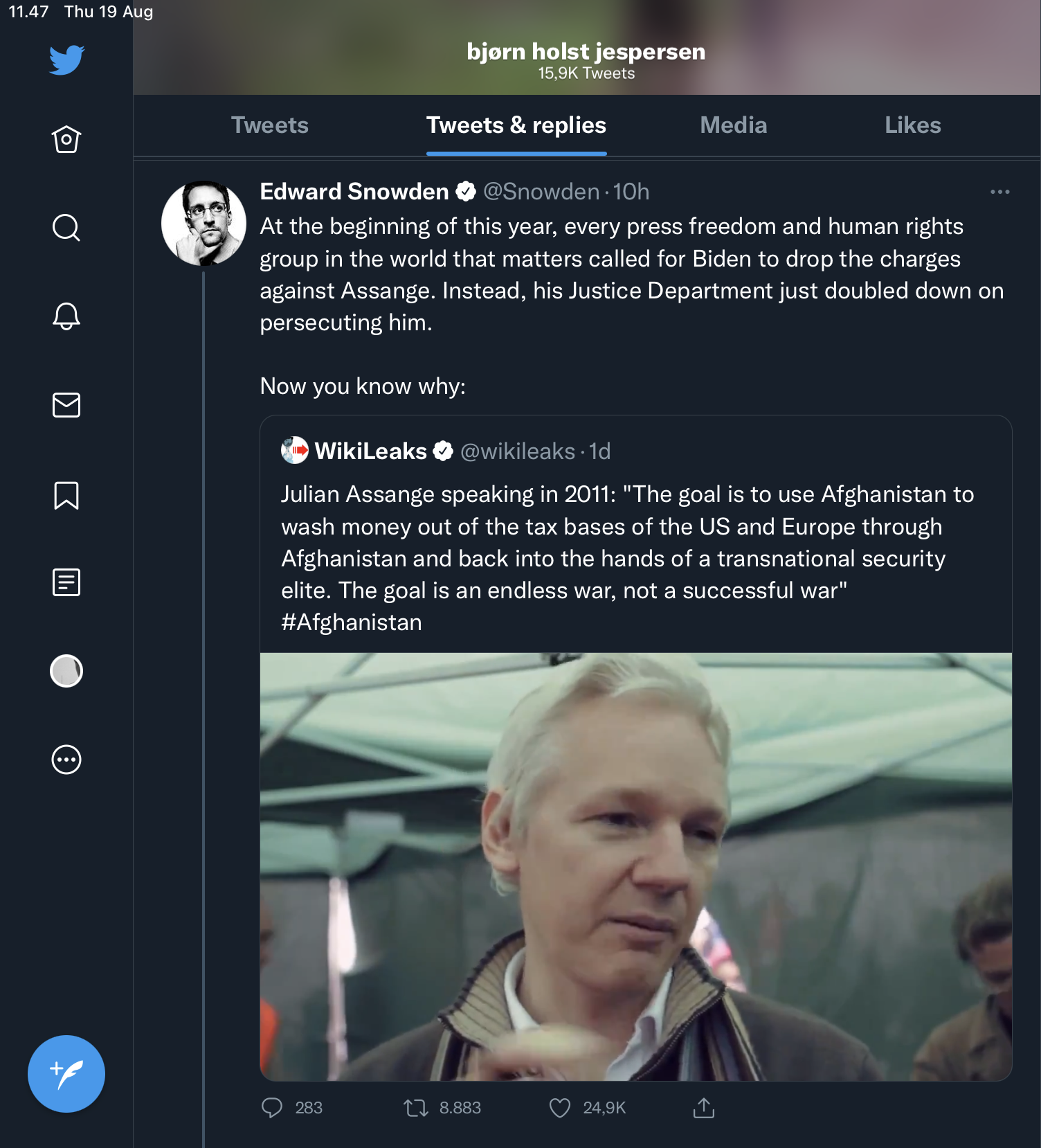 |
An imagined discussion of the method of using the press to strike targets:
A: "yes I see that. You can expose a scam by having someone acting as an agent provocateur while – say – recording the telephone conversation(s) where the scammer makes all the false promises and what have we. And then – if the person never reveals that she/he went in as an agent provocateur – she/he becomes to the World a victim of a crime and her/his recordings becomes proof instead of circumstantial evidence. Right?
- and then; if it can somehow be arranged that it is a journalist/media that makes the case public as a story, instead of trying to use the court system, the objective can be achieved without running the risk of having the material and fake victim scrutinised by police detectives and defence lawyers. Crime ended. No more victims there. Right?"

A: "but could there, never the less, be important reasons to stay away for doing something like that? Why is it for instance that the law doesn't allow it?
- as I see it: not to protect a scammer or what ever, of course, but to make sure the material can be examined, and when it comes to agent provocateurs; then their roll in maybe driving the process must be possible to examine and question too."
A: "and this is important if for nothing else then just to safeguard against simple mistakes but also because it is conceivable, sadly, that the motives driving such an operation might not be just. At times they could be about eliminating persons who for some reason poses an inconvenience instead."
A: "Or in simpler and more general terms: there'll be no safeguards against abuse.
--
added, 2021 - 11 - 30
Afsættet og nutidstilstanden (Danish)
Overordnet ramme:
a) informant-netværket, er meget overdimensionerede i forhold til, hvad der er af reelt efterretnings- og informantarbejde. Dette skyldes at det for størstedelens vedkommende er et beredskab, der skal kunne bruges til at organisere en modstandsbevægelse i tilfælde af en invasion.
b) for at træne medlemmerne og holde moralen oppe er der nogen, der har fundet på, at man kan bruge netværket til at beskytte mod og forhindre forskellige forbrydelser – lidt lissom rigtigt efterretningsarbejde bare i forhold til kriminalitet.
c) beskyttelse mod og bekæmpelse af pædofile bliver et slags trækplaster for deltagelse og en rambuk mod ønsker om at respektere lovgivningsmæssige grænser for anvendelse af mandskabsmæssige og tekniske ressourser samt udøvelse af magt/voldsanvendelse.
Dette må af indlysende grunde forudsætte nægtbarhed – på engelsk: deniability – hvilket giver indsatserne og deres virkemidler et ganske særligt præg.
Modargumentet så langt:
man ville muligvis godt kunne bevæge sig ud i noget i den retning, uden hverken udenomsretslige domme eller straffe, "bare" ved at holde øje og komme i vejen. Og med et stort behov for opgaver til at træne eller udfordre folk, ville mandskabsbehovet ikke være et problem.
Den ændrede karakter af opgaverne ville ikke gøre det relevant at involvere børnene (som beskrevet tidligere), men det vil kun være godt, for det skal de heller ikke. I stedet må en anden form for rekruttering organiseres. Én der ikke perverterer børn i hundredevis på årsbasis (i et land på Danmarks størrelse).
Men er det lovligt for efterretnings-relaterede personer at overvåge personer for at beskytte mod ikke-sikkerhedstruende ulovligheder...det er det nok ikke (må undersøges) men kunne man – hvis man gerne ville – finde ud af at få træningsaktiviterne helt indenfor rammen af lovgivningen? Den udfordring kunne måske i sig selv være en ligeså god træning? (det halter vist stadig lidt med helt at få alternativet på plads, men tænker, at jeg vil se om jeg kan komme videre i den retning)
Sidegevinsten:
man kan bruge netværket i forbindelse med diverse tjenesteudvekslinger med magthavere (politikere, f.eks.).
Hér kan man se et potentielt skred for sig, hvor der opstår en stigende parathed til at anvende dette udenomsretslige magtmiddel for at undgå besværlige situationer – både internt og i forhold til andre nationer.
Yderligere drama-stof:
netværket genererer andre former for korruption i det "almindelige" samfund og i politik (berørt tidligere)
Fordi: hvad vil den selvopfattelse og exceptioneliitets-forestilling der bliver indpodet i store flokke af personer vil betyde for deres syn på lovgivningen generelt? (undersøges nærmere)
I stedet for et korps med professionalitet og faglig stolthed har man opdyrket opgavehungrende fritids-agenter etc etc (mere arbejde hér med potentielle profiler)
Personer, der er korrumperede gennem hele deres opvækst og indpodet med en exceptionellitets-forestilling om sig selv, vil have en lavere tærskel i forhold til at agere korrupt i voksenlivet/arbejdslivet. Vil måske opfatte sig som berettigede til andre regler (antagelser, skal undersøges).
I et nutidsscenarie kan man sætte streg under, hvor problematisk den kurs man har valgt for netværket, er, ved at vise, at det har udviklet sig til et punkt, hvor den interne opfattelse af formål og eksistensberettigelse i netværkets fodfolks-niveauer er væltet væk fra at være et beredskab og over i at være hemmelige vogtere (hvilket vil være ret forståeligt, når de så kan gå rundt og se sig selv som superhelte i stedet for som nogle, der er i venteposition, og som opbygger færdigheder, der med god sandsynlighed aldrig vil komme i anvendelse).
Det helt generelle modargument:
The perfect frame:
If the directing layer can convince the foot-soldier level members of the network, that people about to develop into (sexual) offenders can be identified with certainty, it would then follow that – since such a person haven't committed any offences, yet and therefore can not be convicted – the only way to prevent such a person's for-certain future crimes will be to somehow eliminate or pacify the person without trial.
With a setup like that the directing layer could have the network attack any person the directing layer would want to eliminate (for what ever reason), on the basis of a not-too-hard-to-fabricate psychiatric file.
Notes to add more dimensions to the story:
The brought-up double-lifers will need partners who are also double-lifers if they wish for an honest and intime love-relation, so: how much will it make sense to imagine that is being done to help the young – and not so young – double-lifers form couples?
The idé of an internal contact/dating service seems like a straight forward consequence.
This would also help to maintain the consensus: by pairing the double-lifers, being double-lifers becomes a shared value between the partners, which one can imagine will be preferred to the issue being questioned/challenged by one of the partners.
But people don't control who they fall in love with, so: can outside people who have become partners of double-lifers be brought into the know? That would be a delicate process, and one that would require a prepared way to silence the outsider if this person didn't want to join the activities of the network. On the other hand: is it at all thinkable that a parent-partnership would be viable if one partner is an outsider?
Another aspect to bring into play with regards to the bigger picture:
placing the training and team- and loyalty building outside the intelligence-sphere and in the non-national-security area (targeting "creeps" and scammers etc) and wanting to keep it secret, expands without question and unavoidably the use of national-security measures to areas where they were never meant to be applied.
An undeclared Network interwoven into all areas of society will be able to coordinate accusations against individuals (for what ever reason – could be to remove a perceived threat or perhaps as revenge for some Network member feeling violated in some way).

